Physical Address
60 Ekwema Cres, Layout 460281, Imo
Physical Address
60 Ekwema Cres, Layout 460281, Imo

If you’re hunting for a phone that gives you more than you paid for, the Redmi Note 14 Pro is hard to ignore. With its modern design, smooth screen, and strong battery life, many buyers are actively checking the Redmi Note 14 Pro Price in Nigeria to see how it stacks up against other mid-range options.
Whether you’re upgrading or buying brand new, this phone has quickly become one of the most talked-about choices in its category.
In Nigeria, the Note 14 Pro has generated buzz among tech enthusiasts who seek a big-screen phone with strong battery life and camera performance, but without flagship pricing.
This comprehensive article will cover every aspect of the Redmi Note 14 Pro, from its release date and full specifications to key features. Our goal is to give you an authoritative overview: if you are considering this device, you’ll find all the information you need here.
| Feature | Details |
|---|---|
| Device Name | Redmi Note 14 Pro |
| Release Year | 2024 |
| Network Support | 5G |
| Display | 6.67-inch AMOLED, Full HD+, high refresh rate |
| Screen Protection | Reinforced display glass |
| Rear Camera | High-resolution multi-camera system |
| Front Camera | High-quality selfie camera |
| Processor | Mid-range performance chipset |
| RAM Options | 8GB / 12GB |
| Internal Storage | 128GB and above |
| Operating System | Android-based Xiaomi software |
| Battery Capacity | Large-capacity battery |
| Charging | Fast charging support |
| Audio | Stereo speakers |
| Redmi Note 14 Pro Price in Nigeria (New) | ₦350,000 – ₦450,000 |
| Redmi Note 14 Pro Price in Nigeria (UK Used) | ₦280,000 – ₦330,000 |
| Best For | 5G users, strong performance, long battery life |
| Availability in Nigeria | Jumia, Slot, Xiaomi stores, phone retail outlets |

The Redmi Note 14 Pro was first announced and released in September 2024. Specifically, it made its debut on September, 2024 in Xiaomi’s lineup, initially in markets like India and China. Xiaomi’s schedule often sees these phones arrive in India (as Redmi-branded models) in the fall, followed by a global launch.
In fact, Xiaomi later confirmed that the entire Redmi Note 14 series (including the Pro) would have a global rollout on January, 2025. This global event was expected to include the Note 14 Pro (4G), Note 14 Pro+ (5G), and others.
For Nigerian consumers, this means the Note 14 Pro has been available since early 2025. Xiaomi’s devices often reach Nigeria through official channels a few weeks after global release. By mid-2025, the Note 14 Pro is widely found in the Nigerian market. It launched running Android 14 with Xiaomi’s new HyperOS interface.
Overall, the Note 14 Pro is a very recent model (as of this writing in 2025), so it incorporates modern hardware and software features out of the box.
Also see 20 EasyBuy Phones online in Nigeria | Prices and Specifications
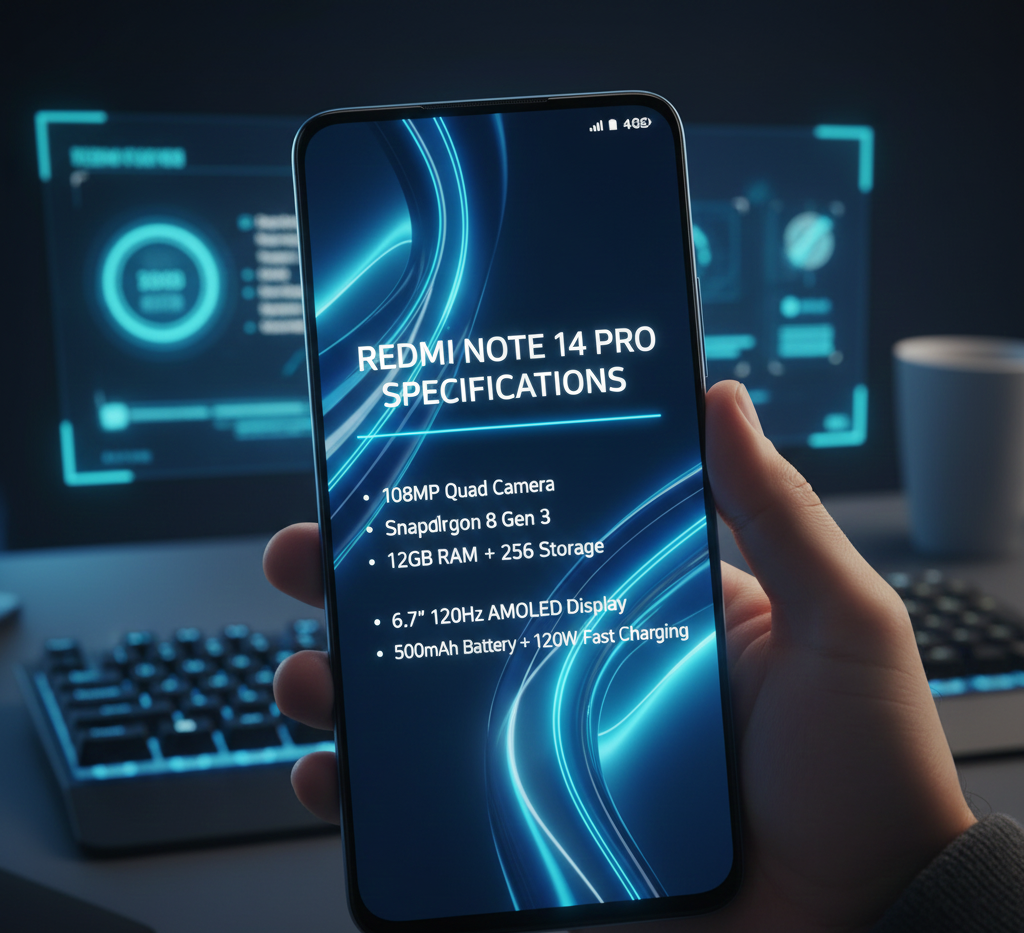
The Redmi Note 14 Pro is packed with attractive specifications for its class. Key specs include a large 6.67-inch AMOLED display at 120 Hz refresh rate, a MediaTek Helio G100-Ultra octa-core processor (built on a 6nm process), 8GB of RAM (with an option for 12 GB), and storage variants of 128 GB or 256 GB (UFS 2.2).
The phone is also designed with an enormous 5500 mAh battery supporting 45W fast charging. On the back, it has a triple camera array led by a 200 MP main sensor, accompanied by an 8 MP ultrawide and 2 MP macro lens. The front selfie camera is 32 MP. It runs Xiaomi’s new HyperOS (which is based on Android 14).
Connectivity covers the essentials: 4G LTE, Wi-Fi 5, Bluetooth 5.3, NFC, and dual SIM support. The build includes features like an IP64 splash-resistant rating and an in-display fingerprint sensor.
In the following sections, we delve into each of these categories in detail (Display, Camera, etc.) to explain what this phone offers. The Note 14 Pro aims to deliver a near-flagship experience (especially in camera and display) at a midrange price point, and its specs reflect that balance.
The Redmi Note 14 Pro sports a 6.67-inch Full HD+ (2400×1080) AMOLED display. This large panel offers sharp visuals (roughly 395 pixels per inch) and vibrant colors due to its wide DCI-P3 color gamut support. The panel can hit very high peak brightness levels (up to 1800 nits) for excellent outdoor visibility.
It’s protected by Corning’s Gorilla Glass Victus 2, so it’s quite tough against drops and scratches. Notably, the display has a high 120 Hz refresh rate, which makes animations and scrolling feel very smooth – a premium feature that improves user experience in gaming and UI fluidity.
Additional display features include 10-bit color depth (over 1 billion colors) and HDR support, which make video playback look richer. Xiaomi also integrated features like Reading Mode and Sunlight Mode to optimize legibility in various conditions. For users who watch a lot of videos or play games, this bright, smooth AMOLED screen is a strong selling point.
The Note 14 Pro’s display is high-end for a midrange phone, offering both high refresh rate and excellent color/brightness performance.
See also: Xiaomi Redmi Note 13 Pro+ 5G: Specs and Price in Kenya|2025
The camera system of the Redmi Note 14 Pro is one of its biggest highlights. Xiaomi equipped it with a triple-lens setup on the rear:
200 MP main camera: This is an ultra-high-resolution sensor (likely using pixel binning to combine 16 pixels into one for better low-light performance, yielding an effective 12.5 MP image by default). It has optical image stabilization (OIS) and a bright f/1.65 aperture. The large sensor and OIS make it great for detailed daytime shots and improved night photography.
8 MP ultra-wide camera: The secondary lens is 8 MP with a wide-angle field of view. This lets you capture landscapes or group photos in a single frame. The aperture is f/2.2 (relatively wide for an ultra-wide).
2 MP macro camera: The third lens is a simple 2 MP macro camera (f/2.4), which can focus on very close subjects. It’s a nice addition for macro shots, though at 2MP it’s more of a novelty.
On the front is a 32 MP selfie camera (f/2.2), embedded in a small hole-punch at the top of the display. This high-res front camera can record up to 1080p video at 30fps.
The Note 14 Pro’s camera software includes features like Night mode, AI scene detection, and various shooting modes (portrait, panorama, etc.). The primary sensor’s 200 MP can capture enormous detail. In good light, photos are very crisp and vibrant. The ultra-wide lens is decent but not as sharp as the main one (common in most phones). The macro camera works only in very close range.
Overall, for a midrange phone, having a 200MP main camera is unusual and gives the Note 14 Pro an advantage if you want extremely high-detail shots or extensive cropping ability. Just keep in mind that native 200MP images are large files.
For video, the phone can shoot 4K at 30fps (with some stabilization) and 1080p at 60fps. Xiaomi also offers 1080p super slow-mo at 960fps with lower resolution (a software trick).
In everyday use, you’ll find the camera experience on the Note 14 Pro to be excellent for the price – especially for daylight photography. The big sensor ensures good performance even when light is low, which is often a weak spot on cheaper phones.
Powering the Redmi Note 14 Pro is the MediaTek Helio G100-Ultra processor. Despite sounding like a midrange chip (it’s in the same family as the Helio G series), Xiaomi has tuned it to deliver solid performance for everyday tasks. It’s an octa-core CPU built on a 6nm process (meaning good power efficiency).
Alongside this, the phone ships with 8 GB of RAM by default (there may be a 12 GB version as well, depending on region). The combination of a modern 6nm chip and ample RAM means the Note 14 Pro can handle multitasking, apps, and games quite capably.
In normal use – browsing, social media, streaming video – the phone feels responsive. Apps load reasonably fast, and the UI transitions are smooth (aided by the 120 Hz display).
For gaming, it’s not a powerhouse like a Snapdragon 8 series, but it can run popular games (e.g. PUBG Mobile, Call of Duty Mobile) at medium to high graphics settings without much trouble. The phone’s performance is good enough for most users; only very heavy users or competitive mobile gamers might notice it doesn’t match high-end chipsets.
For storage speed, the UFS 2.2 storage (where available) keeps app installation and file transfers efficient. Overall, the Note 14 Pro’s performance is appropriate for its price point. It won’t win benchmark wars, but it delivers a smooth experience for daily smartphone use and moderate gaming.
Xiaomi has given the Redmi Note 14 Pro a 5500 mAh battery, which is quite large. This generous capacity means the phone easily lasts all day on a single charge for most users. In practice, you can expect a full day or more with mixed usage – the efficient display (AMOLED) and processor help stretch battery life. Even heavy users often find it getting through the day and only needing a recharge at night.
The phone also supports 45W fast charging, and the box includes a 45W charger. This means you can top up the battery quickly – roughly 0-50% in about 20-30 minutes in tests. Having 45W on a midrange phone is a premium touch. It also supports 45W over USB-C charging, so recharge is convenient with a cable.
There’s no wireless charging on this model, which is common for this price range. But the speedy wired charging more than makes up for it. Xiaomi also includes battery-saving modes in software to further extend runtime if needed (by limiting background activity or reducing performance).
Battery life is a strong suit of the Note 14 Pro. The 5500mAh pack ensures very long endurance, and the 45W charger means you can quickly recover when needed. This combination is excellent for users who often forget to charge regularly or who use their phone extensively on the go.
The Redmi Note 14 Pro comes with ample storage options. Out of the box, it offers 128 GB or 256 GB of internal storage, paired with the RAM options (8/12 GB). This should be sufficient for most users’ apps, photos, and videos.
Importantly, Xiaomi also provided a microSD card slot (via a hybrid SIM tray). You can expand the storage by inserting up to a 1TB microSD card, which is great if you plan to store a large media library or many downloaded files.
Data transfer speeds are decent, thanks to UFS 2.2 in some models. File copies, app installs, and media loading are snappy. There’s also an option in software to use the microSD card as additional internal storage (though performance is best when using it as normal removable storage).
storage on the Note 14 Pro is very flexible: plenty of internal space plus room to grow via microSD. This caters well to users who need a lot of space (like photographers or power users) without having to pay a huge premium for a higher built-in storage variant.
Xiaomi’s Redmi Note 14 Pro ships with HyperOS – Xiaomi’s latest Android-based operating system (essentially Android 14 with Xiaomi’s customizations). HyperOS provides a clean and modern interface with features borrowed from both MIUI and a more stock Android feel. Users get full access to Android’s feature set (notifications, multitasking, etc.) plus Xiaomi’s enhancements like customizable themes, privacy controls, and game/reading modes.
Out of the box, the Note 14 Pro comes with some Xiaomi apps (like Mi Browser, Mi Video, etc.), but Google’s core apps (Gmail, YouTube, Play Store) are also pre-installed for the Nigerian market. At launch, the phone is up to date with Android 14, and Xiaomi typically promises a couple of major OS updates for its Note series (so one could expect Android 15/16 in the future, though this can vary by region). Security updates are provided periodically as well.
Software features of note include a split-screen mode for multitasking, a reading mode that tints the screen to warmer colors, and an in-built ad blocker. The camera app software is user-friendly and offers AI scene detection. There’s also support for HDR video and gaming optimizations (e.g. disabling notifications).
In summary, the Note 14 Pro’s software is modern and feature-rich. It provides the latest Android experience at launch, with Xiaomi’s usability improvements layered on top. Users transitioning from other Android phones will find it familiar but with additional handy tools.
Connectivity options on the Redmi Note 14 Pro cover all the essentials. It is a 4G LTE device (no 5G) – using network standards like LTE FDD/TDD for fast mobile data. You can insert two nano-SIM cards simultaneously. Wi-Fi 5 (802.11 a/b/g/n/ac) allows high-speed local network connections, and Bluetooth 5.3 ensures stable pairing with accessories like earphones or speakers. The Note 14 Pro has NFC, enabling contactless payments or fast pairing with devices.
For navigation, it supports GPS, GLONASS, Galileo, and BeiDou systems, so location services should be accurate. It also has a USB Type-C port (USB 2.0) for charging and data, and like Samsung’s S10, it includes a 3.5mm headphone jack. This is great for users who prefer wired headphones. Unlike the S10 which had a headphone jack, it’s somewhat rare to see this feature at higher price points, so it’s a nice inclusion here.
One more feature: the Redmi Note 14 Pro is listed with an IP64 rating. This means it has some ingress protection – it’s dust-resistant and can handle splashes of water. However, IP64 is not as robust as IP68 (it mostly just guards against light water exposure, not full submersion). So it’s splash resistant but don’t take it swimming. Still, for everyday use it offers extra durability against spills or rain.
Overall, the phone’s connectivity suite is very comprehensive. It lacks only 5G (which is expected at its price) but includes everything else from Bluetooth to NFC to dual SIM.
For audio, the Redmi Note 14 Pro provides stereo sound via two speakers: one at the bottom and one integrated near the top (often dual use as the earpiece speaker). While not as loud as a tablet, the stereo output is clear and offers decent fullness. Xiaomi has added Dolby Atmos support, which can widen the sound field for video and music (especially when using headphones).
Importantly, the phone retains a 3.5mm headphone jack. This means you can plug in standard earphones directly without needing an adapter, a valuable feature for many users.
The headphone output is said to be high-quality, and the presence of a jack with headphone amplifier circuitry means it should drive even higher-end wired headphones fairly well. The Note 14 Pro also supports high-resolution audio playback, so audiophiles can benefit from FLAC files or similar.
When using Bluetooth audio, it supports modern codecs up to AAC/LDAC (check the exact supported codecs in specifications). Battery-wise, using wired headphones conserves battery, and you can still charge via USB-C while listening (or even use a dongle through USB-C). The phone does not have an FM radio built-in.
Sound output on the Note 14 Pro is above average for its class. The stereo speakers, Dolby Atmos, and headphone jack give flexibility – whether you want to play music out loud or use quality earphones.
The Nigerian price for the Redmi Note 14 Pro depends on storage configuration and market conditions. Based on recent retailer listings in Nigeria, the 8GB RAM/256GB storage variant is priced around ₦370,000–₦380,000. For instance, Jiji listings show new (or “like new”) Note 14 Pro units (8/256GB) at approximately ₦375,000 to ₦380,000. Konga’s official store lists the same 8+256GB configuration at ₦369,800.
There may be a slightly lower-priced 128GB model (if offered in Nigeria), and a more expensive 12GB/512GB model (if available) which could go above ₦400,000. But the typical selling price for a new 8+256GB Note 14 Pro is around ₦370k.
This places it above lower midrange phones (like the Redmi 14C, which sells much cheaper), but below true flagships. Given its specs (especially the 200MP camera and large battery), this price is considered competitive.
No, the Redmi Note 14 Pro is a 4G-only smartphone. Its chipset (Helio G100-Ultra) supports LTE networks but does not include 5G modem hardware. In other words, you cannot connect to 5G cellular networks with this model. Xiaomi did release separate 5G variants in the Note 14 lineup (such as the Note 14 Pro+ 5G and Note 14 5G), but the base Note 14 Pro (the standard model) is limited to 2G/3G/4G connections.
For Nigeria specifically, 5G is still in very early stages of roll-out, so a 4G phone is not a major handicap at this point. The Note 14 Pro supports advanced LTE bands and can achieve high 4G speeds on networks that allow it. But strictly speaking, it does not have 5G.
Also Read: 10 Latest Redmi Phones and prices in Nigeria
As of now, the Redmi Note 14 Pro is mostly sold through third-party sellers on Jumia rather than as an official Jumia item. Notably, Jumia’s official store lists the higher-tier Redmi Note 14 Pro+ (5G) model (8GB/256GB) at around ₦534,721. This gives a sense of pricing for the 5G variant.
The standard Note 14 Pro (4G) itself may not be explicitly listed, but its price would logically be lower than the Pro+ model. Given Konga’s price (~₦369,800), one could estimate the Jumia price for the Note 14 Pro to be in the same ballpark (~₦370k).
In any case, Jumia does offer Xiaomi phones through various official and semi-official channels. If you search Jumia on the Note 14 Pro, you might find listings by independent sellers. It’s advisable to compare those with Konga or other shops.
But from available data, expect the Note 14 Pro (8GB/256GB) to be around ₦370,000–₦380,000 if sold on Jumia. Meanwhile, Jumia’s listing for the Note 14 Pro+ 5G (which is a different, higher-end model) sits at ~₦534k.
Since the Redmi Note 14 Pro is very new, UK-used units are not yet common in Nigeria. Most listings for this phone currently in Nigeria are brand-new. However, if and when UK-sourced or other foreign units become available, they would likely sell for slightly below the new retail price. As a rough analogy, look at the S10 – used imports go for maybe 15–20% less than new.
For the Note 14 Pro, if new is ~₦370k, a high-quality used import might land in the ₦280k–₦330k range, depending on condition. Indeed, even now some classified listings indicate used or “foreign” units: Jiji shows a “foreign used” Note 14 Pro (12GB/256GB) at ₦360,000. This suggests that the used price is only modestly discounted (likely because the phone is so new).
In summary, if buying a UK-used Note 14 Pro in Nigeria, expect to save a bit off the fresh price but not a huge margin. And as always with used imports, verify the condition and that the phone is unlocked and legit before buying.
Checking Slot Nigeria (the multi-brand electronics retailer), it appears they have not yet stocked the Redmi Note 14 Pro. A search of their catalog for “Note 14 Pro” returns no results (the search shows other Xiaomi models but not the Note 14 Pro). As evidence, Slot currently lists the older Redmi Note 13 Pro (8GB/256GB) at ₦414,800.
Since the Note 14 Pro is newer, Slot may introduce it soon or it may not be carried at all (Slot’s inventory often lags behind the newest launches). If and when Slot starts selling it, one might expect a retail price similar to or slightly above Konga’s (around ₦370k) – perhaps in the ₦380k–₦400k range. However, without an official listing, we can only infer from existing models.
Therefore, as of now: Slot Nigeria does not have a quoted price for the Redmi Note 14 Pro, implying it’s not available through their official channels. Customers interested in this model should instead look to other vendors.
Check out Redmi Phones Under 30,000 in Nigeria | 2025
Whenever buying offline, it’s good to confirm whether the unit is brand-new, sealed and includes an official warranty card. Also, compare prices: physical stores might charge slightly more than online, but they allow you to see the phone before purchase.
Read Also: Redmi A5 Price in Nigeria | Full Phone Specification
Yes, the Redmi Note 14 Pro is generally considered a good mid-range phone for casual users
Neither Redmi nor Samsung is universally “better”; Redmi offers superior value with high specs (fast charging, big batteries, cameras) for less money, while Samsung provides a more polished, reliable experience with longer software support (updates), premium design, and cleaner One UI, though often at a higher cost or with fewer extras in the box.
It does a solid job in good lighting, as seen in test photos, with results that are not bad at all
The Redmi Note 14 Pro emerges as a very compelling midrange smartphone for Nigeria. For its price point, it delivers features often found in much more expensive phones.
Given its specs, the Note 14 Pro is particularly attractive for users who want long battery life and a top-tier camera without paying flagship prices. Nigerian customers should evaluate offers from both online and physical stores, look out for any promotions, and decide based on warranty and service needs.
Anyone in the market for a big, modern Android phone in 2025 would do well to consider the Note 14 Pro.