Physical Address
60 Ekwema Cres, Layout 460281, Imo
Physical Address
60 Ekwema Cres, Layout 460281, Imo

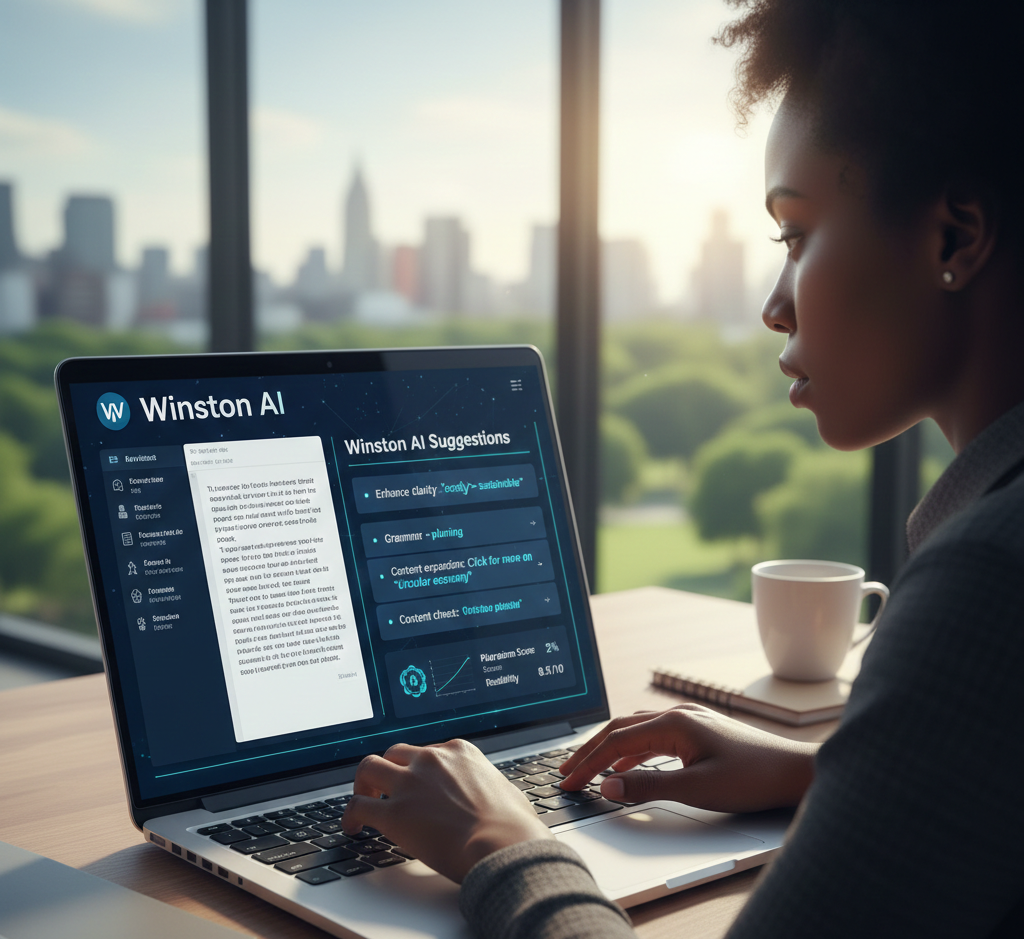
A lot of AI-written contents flooding the online space, there is a need to identify whether a text has been written by a human or it has been produced by artificial intelligence, to avoid high bounce rate.
Winston AI is useful to check authorship and originality in the current digital environment, in which AI-generative models such as ChatGPT and Google Gemini generate vast quantities of text.
It boasts of being the most reliable AI detector and a plagiarism checker.
Keep reading through this piece to get more information about Winston AI; its features, uses, and how it works to detect AI generated contents.

Winston AI is a software platform that is created to analyze text in order to determine whether it is original or not.
The main task of it is AI content detection – it analyzes text to ascertain whether it is probably composed by a human or an AI model.
Also Winston has an in-built plagiarism detector, which searches through copied or properly sourced material.
Winston operates with machine learning models that are trained on vast sets of machine-written text that was written by humans and vice versa.
These models compare style of writing, use of words, and syntax among other linguistic characteristics so as to conclude.
Winston is sold to schools, publishers, SEO specialists, and any other person worried about the originality of content.
Explore the 12 Best AI Market Research Tools for Tech Projects
The functionality of Winston AI is based on content analysis and reporting. Its main features include:
The main work of Winston is to identify whether the text is written by a human or by a machine. It aids in identifying the content of a number of AI models (ChatGPT, Gemini, Claude, and others) with an estimated accuracy score of 99.98.
The interface is used to perform a Basic Scan (free, limited length) and an Advanced Scan (more profound analysis and sentence-level accuracy).
Winston has an inbuilt plagiarism detector to check authenticity. The system search systematically compares the input text with a huge database of sources and indicates any passages that match published work.
This comes in handy to make sure that there is no unauthorized copying done.
Winston focuses on the fact that detecting of plagiarism will work with a variety of languages and will be able to handle the references with a simple review.
Once a text has been analyzed, it is possible to create a full report that can be shared with other people (e.g., colleagues, students, or editors).
These reports contain charts, scores, and flagged sections, which give transparency as to why the tool rated content the way it did. It is useful in the school or business world where the analysis has to be supported.
Winston also provides writing improvement features besides being able to detect the writing. It offers advice on clarity, tone, and structure to enable users to refine their content.
Although it is not its primary focus, this feature can help writers to make their text more interesting and free of mistakes.
Winston is able to interpret text to more than a dozen languages. Some of the languages that are supported currently are English, Spanish, French, Chinese, and German, among others.
This wide acceptance renders it helpful to foreign users.
In addition to text, Winston can scan an image to determine whether it is an AI-created image (as with models such as DALL-E or Midjourney).
Although this is a different tool within the suite offered by Winston, it shows how the company is more concerned with authenticity.
As a developer and business, Winston offers an API that allows you to combine its detection features with other applications or processes.
As an example, a school would automatically scan submissions by students, or an article would be batch-vetted before publication by a publisher.
Winston claims industry-leading accuracy. It is trained on “the largest dataset of human-reviewed data” and updated weekly to stay ahead of new AI text generation techniques.
Basically, Winston is constantly upgrading its model to develop the ability to identify even advanced AI writing.
The web application is user-friendly: one only needs to copy a text or drag and drop a file, and the analysis is performed in seconds. It has an intuitive and clean dashboard, which is commonly stated positively in user reviews.
Winston is school and business-friendly with several user accounts, student control, and usage statistics. These business solutions provide group license and privacy controls.
These features make Winston AI a comprehensive tool not just for picking out AI content, but for ensuring overall content integrity.
Check out the 10 Best Google Ads AI-Powered Tools to Help Marketers Ad Campaigns
Winston AI is used wherever there is a need to verify written content. Key use cases include:
Winston is used by the teachers and administrators to determine whether the student essays are original or whether the AI tools were misused. For example, an English professor mentioned using Winston during audits and found it to be “the most accurate AI detection solution on the market”.
School districts integrate Winston to add AI checks to assignment grading to save academic honesty. It is also used to detect plagiarism in student work.
Winston helps writers, marketers, and SEO experts to ensure that the content on the web pages looks as natural as possible and that it is not detected by the search engines.
It has been indicated by many platforms (such as Google) that they could punish text that is either generated by AI or has no originality.
Winston assists in ensuring that human quality is preserved in content teams, and this may safeguard search ranking.
Winston can be applied to academic publishing to screen submitted manuscripts. To be credible, it is important to ensure that scientific papers or articles are not generated by AI (or plagiarized).
This is because the detailed reports written by Winston can help editors go through submissions.
Winston can be used by corporations and business entities that create white papers or reports and marketing literature to certify that the professional documents are not AI churned.
It may be significant in terms of branding and legal aspects. The workspace team cooperation features are even made in the business of Winston, which favors the workflow in the workplace.
This can be used by the newsrooms and publishers to check that Winston is not generating the articles with bots but rather it was an actual journalist who wrote the article.
This comes in the upholding of editorial standards. The fact that Winston is capable of flagging AI content fast is useful in media where there is a lot of movement.
Freelancers have an opportunity to proofread their writing and submit it to the customers without committing unintentional plagiarism or excessive robotism.
It also can convince them of the humanity of the content they are dealing with.
Read about 10 Free Tech Training in Nigeria
Students learning writing skills might use Winston to gauge whether their essays sound authentically human. Some language learners may practice writing and check against Winston’s feedback.
In fields like legal writing or compliance documentation, originality is vital. Winston can assist the firms in making sure that internal or external papers are not duplicated to the existing legal texts accidentally.
Academic Researchers interested in AI and language generation can apply Winston to label and sort large text data sources into human and AI-generated material, using its high accuracy and API.
The uses are ultimately about content integrity: ensuring that writing is authentic, whether in education, SEO, publishing, or business.
Read also: What Is Janitor AI? Features, Uses, & How It Works
Winston AI is based on the implementation of advanced linguistic analysis to text, using machine learning and statistical techniques to distinguish human writing and machine-generated text. The following is a summary of its operation:
The user enters text to be analysed. It can be performed through the ability to paste text into the web form, upload a document ( PDF, DocX, and so on ) or input a URL. Each option has an interface in the system.
Winston preprocesses the text first: it removes formatting, plain text is extracted and the content is divided into sentences or paragraphs. This is significant in its sentence-level analysis and plagiarism comparison.
The fundamental AI detector is a trained model that, through learning, acquired attributes of human vs. AI writing. This, according to FAQ by Winston entails analysing patterns like word choice, structure of grammar, coherence, among other minutiae.
In particular, according to the documentation provided by Winston, its model has been trained with a large, human-reviewed dataset and is constantly updated to handle various content.
As a result, the detector identifies linguistic cues like overly formal phrasing or lack of personal anecdotes (common in AI text) to make its judgment. It assigns a probabilistic “human” score to each sentence or the whole text.
Winston has one unique feature: sentence-level highlighting. Winston is able to give a probability that each sentence in the text was generated by an AI.
Assuming sentence length surpasses some predetermined maximum AI-probability, Winston notes it. This granularity assists the users in knowing precisely the areas of the content that are troublesome. Sentences will be color-coded or annotated to the interface as a rule.
Check out to see the 10 Tech Millionaires in Nigeria
Winston, at the same time, performs a plagiarism check. It receives the text and matches it to its source database and internet sources. Passages that closely match published material are flagged.
Winston can manage citations and show where duplicate content was found.
After analysis, Winston compiles the results into a report. This includes the overall “Human vs. AI” percentage, any flagged sentences (with highlights), and any plagiarism hits.
It computes summary statistics as well. Winston could be made to generate a downloadable report (PDF or HTML) containing all findings, should this be requested by the user.
The detection models that Winston uses are constantly updated. They state that they will update on a weekly basis to add new examples of AI writing.
This is critical because new AI-writing tools constantly emerge. By retraining on recent data, Winston stays current.
The user can review the output interactively on the website. Winston may also provide writing tips or allow re-scanning after edits. For professional users, an API integration means these steps can be automated within other applications.
In simpler terms, Winston processes text through its proprietary detection engine, looking for signals of machine-generation, then presents a detailed analysis to the user.
It essentially scores writing on how “human-like” it is based on its training. The result is a clear indication – a percentage score and highlighted sections – that helps the user understand the origin of the text.
The fact that Winston focuses on high accuracy (99.98% detection) implies a very large and finely tuned model. When the process is completed, you receive the verdict (probably a human or probably an AI) and evidence of it (the flagged sentences) so that you can take relevant action (edit the text, cite sources, or believe it to be authentic).
See also: Top 15 AI Game Generators
Winston AI sets the standard in AI content detection with its unmatched accuracy in identifying ChatGPT, Claude, Google Gemini and all known AI models
The free plan is actually a 14-day trial
Winston AI is more balanced
With the increase in the use of AI-generated text, applications such as Winston AI will remain an essential part of ensuring credibility in online content. It is both the most advanced analysis and convenient reporting tool to someone who needs to be assured that their content is indeed, written and original by humans.